Remote work in Nepal
Nepal for digital nomads: internet, costs, visas and best places
An honest guide to internet, electricity, living costs, visas and the best places to work remotely from Nepal.
Last verified: 15 July 2026

The honest verdict
Nepal can be a rewarding remote-work base for people who value affordability, culture, nature and slower travel. Kathmandu, Patan and Pokhara provide the most dependable combination of fibre internet, electricity, accommodation and professional services. Rural stays can offer exceptional peace and access to nature, but connectivity and power backup must be checked property by property. Nepal is promising, but it is not yet as frictionless as established digital-nomad hubs.
Best suited to
- Remote workers paid by an overseas employer
- Freelancers serving international clients
- Independent founders and creators
- Travellers planning a one-to-three-month stay
- People combining focused work with trekking, culture or nature
- Workers with flexible hours rather than fixed North American schedules
Think carefully if
- Every working minute requires guaranteed uninterrupted connectivity
- You have serious respiratory sensitivity and plan to stay in Kathmandu
- You must work normal North American daytime hours
- You expect reliable broadband in every mountain village
- You plan to take local employment without confirming immigration requirements
- You require highly specialised medical care nearby
Nepal for remote work: at a glance
An editorial scorecard, not a numeric rating or review — each line reflects NepalPick’s research judgement and should be reconfirmed against your own priorities.
Use this guide
Can you work reliably online in Nepal?
Fibre internet is widely available across Kathmandu Valley and central Pokhara, and it has expanded into many secondary cities and municipalities. Major providers include WorldLink, Nepal Telecom, Vianet, DishHome, Subisu, Classic Tech and CG Net. Availability does not guarantee equal performance in every building. The actual experience depends on the local connection, router, shared users, building wiring and provider response time.
The Nepal Telecommunications Authority reports more than three million fixed-broadband subscriptions, and Fibre to the Home (FTTH) is now the dominant fixed-broadband technology. That is a national trend, not a guarantee for any single address — NepalPick does not publish one national speed figure as a promise.

Before booking accommodation, ask for:
- A recent speed-test screenshot from the exact room or workspace
- Download speed
- Upload speed
- Latency or ping
- Whether the connection is shared
- The Internet Service Provider (ISP) name
- Whether the router remains powered during an outage
- Whether a second connection is available
- Whether video meetings are normally stable
- Whether mobile signal works inside the property
Nepal Telecom and Ncell are the two principal mobile options. Check both networks before committing to a property, since mountainous terrain creates real local coverage differences between them. For short-trip tourist SIM logistics — registration documents, pricing, and route coverage rather than a long-stay broadband assessment — see Nepal SIM card.

Nepal experienced a major upstream broadband disruption in May 2024. It was a real, disruptive event, not the norm — but it is exactly the reason network redundancy is worth planning for rather than assuming away.
Sources: Nepal Telecommunications Authority · Nepal Telecom · Ncell · AP News, May 2024 broadband disruption
Electricity is far more dependable than Nepal’s old reputation suggests
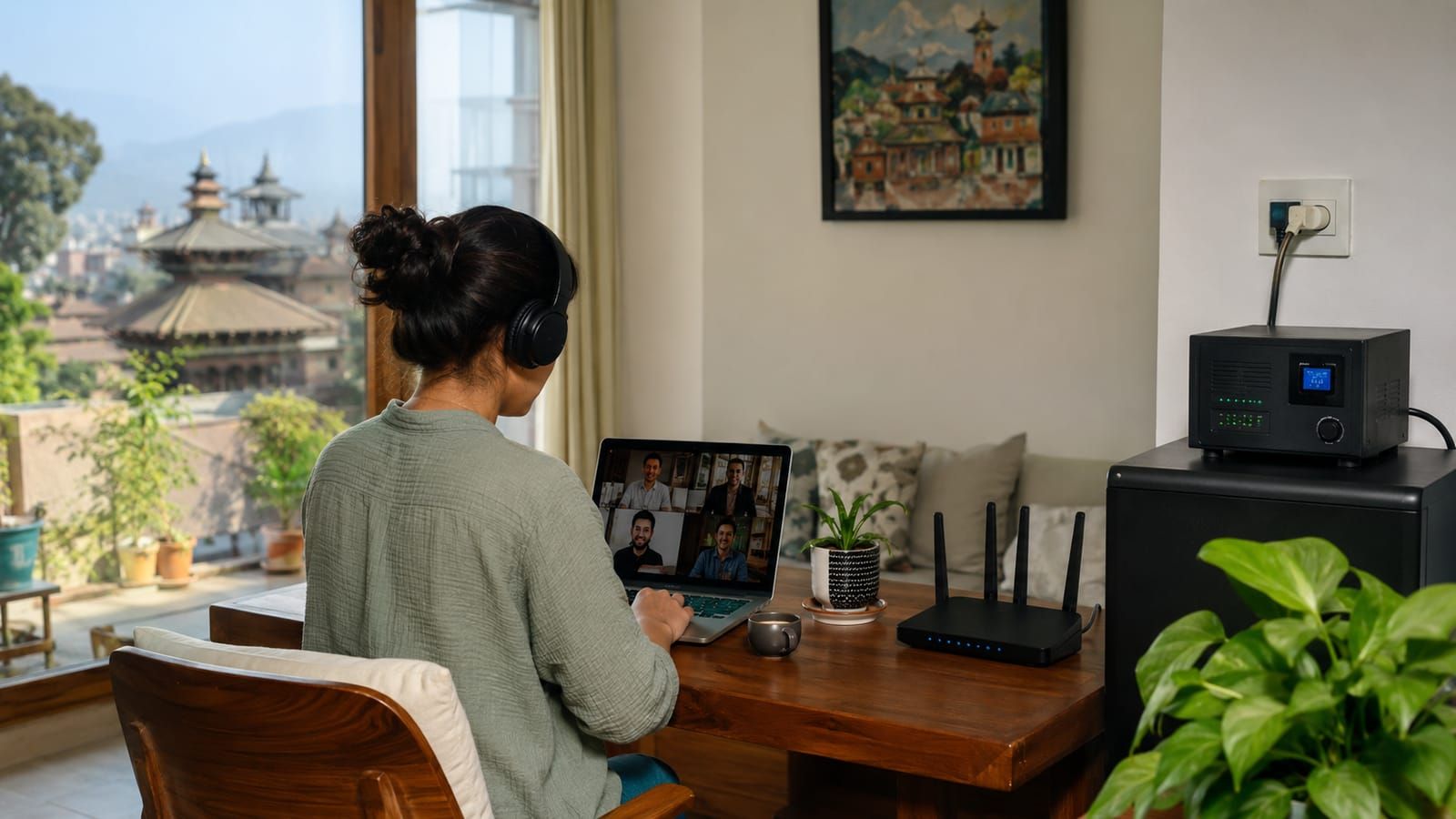
Nepal’s historic scheduled load-shedding crisis ended in 2018. Electricity access has expanded dramatically, and hydropower produces most of the country’s electricity. Remote workers should nevertheless plan for occasional local faults, maintenance, construction damage and weather-related interruptions — Nepal does not promise uninterrupted power, and neither does this page.
Property backup hierarchy
- Best: Full-building inverter, battery, solar or generator supporting sockets and internet
- Good: Battery backup supporting the router and selected sockets
- Minimum: Charged laptop, large power bank and mobile-data backup
Ask readers to confirm whether backup power supports:
- The internet router
- The desk socket
- Lighting
- Heating or cooling, if important
- The property's water pump
Sources: World Bank electricity-access data · Nepal Electricity Authority · AP News · Reuters, Nepal power exports
What does a month of remote work in Nepal cost?
These are indicative planning estimates, not quoted market prices, based on NepalPick’s own research. Confirm current rents, coworking fees and season-driven price swings before committing to a booking.
These ranges exclude international flights, major trekking expeditions, specialist equipment, comprehensive insurance, personal tax, expensive nightlife, luxury hotels, and emergency evacuation.
A sample comfortable monthly budget
| Category | USD (per month) | NPR (approx.) |
|---|---|---|
| Furnished accommodation | USD 350–700 | NPR 54,000–NPR 107,000 |
| Food and groceries | USD 220–400 | NPR 34,000–NPR 61,000 |
| Internet and mobile data | USD 20–50 | NPR 3,000–NPR 8,000 |
| Coworking | USD 50–160 | NPR 8,000–NPR 25,000 |
| Local transport | USD 40–120 | NPR 6,000–NPR 18,000 |
| Utilities and laundry | USD 30–90 | NPR 5,000–NPR 14,000 |
| Leisure and short trips | USD 100–300 | NPR 15,000–NPR 46,000 |
| Visa and administration | Variable, confirm current official fees | |
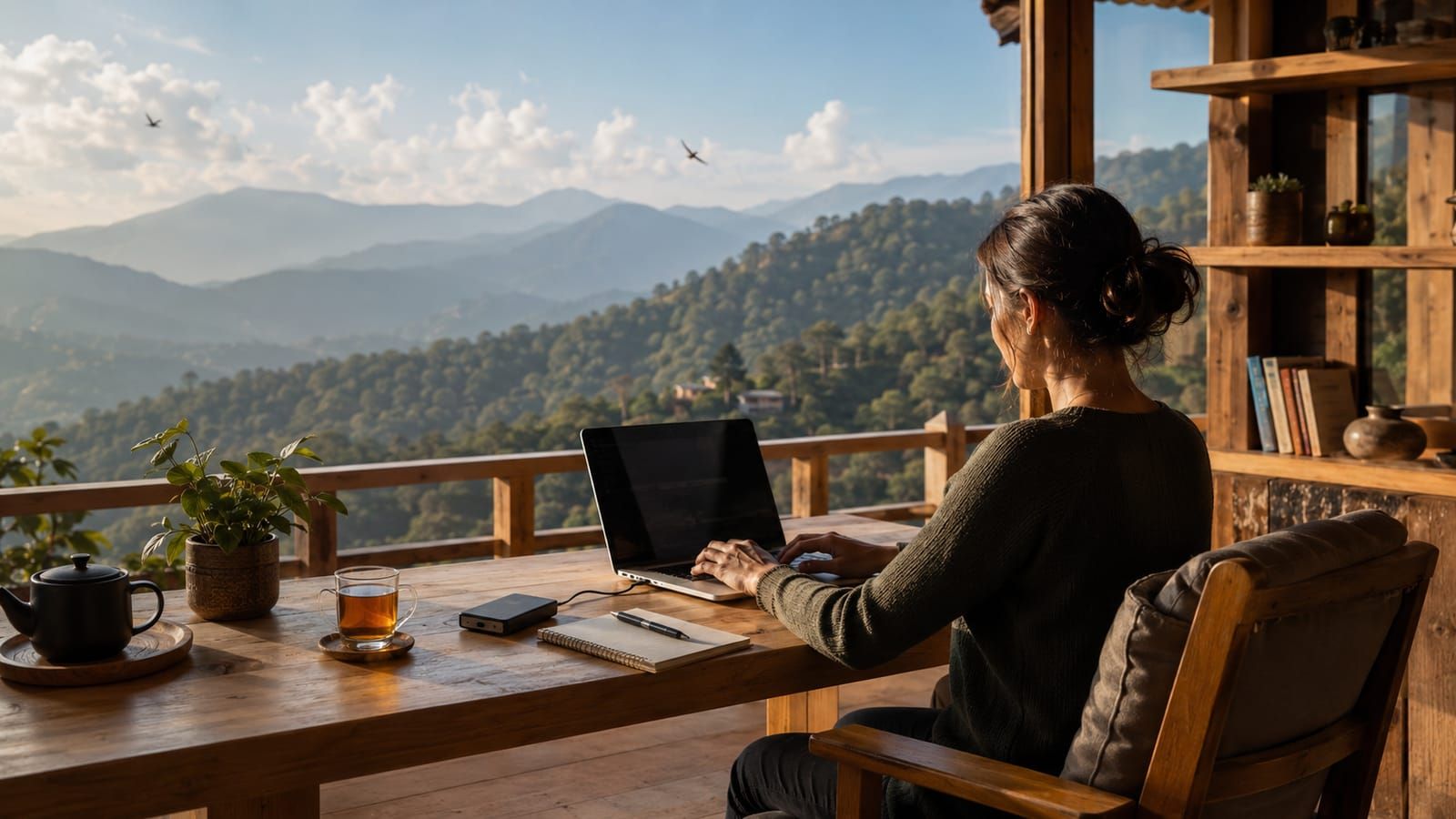
International short-stay platforms can be considerably more expensive than locally negotiated monthly accommodation. Patan, Jhamsikhel, Sanepa and central Pokhara often command higher rents because they are popular with international residents. Heating can add cost during winter because many buildings lack central heating, and air conditioning may matter in hotter lowland locations. None of these figures are guaranteed current prices — see the sources section for a review schedule.
Best places in Nepal for remote workers
No single base suits every remote worker. The comparison below groups Kathmandu Valley’s main options, then quieter heritage and short-retreat alternatives, then mountain and rural locations that reward a different kind of trip.

Kathmandu Valley and Pokhara
Patan and Lalitpur
Best for: longer stays, cafés, coworking, heritage and a calmer base within Kathmandu Valley.
Strengths
- Strong fibre availability
- Attractive neighbourhoods such as Jhamsikhel and Sanepa
- Restaurants and cafés
- Access to Kathmandu services
- Patan’s heritage environment
- Easier daily pace than the busiest parts of Kathmandu
Limitations
- Popular foreign-resident areas can be relatively expensive
- Kathmandu Valley traffic and pollution still affect the area
- Building quality and backup power vary
Kathmandu
Best for: first-time arrivals, networking, specialist services and short stays. See the Kathmandu itinerary for orientation.
Strengths
- International airport
- Largest selection of accommodation
- Strongest professional and coworking ecosystem
- Best access to specialist hospitals
- Extensive fibre and mobile coverage
- Major restaurants, shops and services
Limitations
- Traffic
- Noise
- Winter and pre-monsoon air pollution
- Thamel can be distracting for long-term focused work
- Travel time varies greatly by neighbourhood
Pokhara
Best for: nature, slower stays, weekend activity and a calmer lifestyle. See Pokhara slow travel for the wider destination guide.
Strengths
- Phewa Lake and outdoor access
- Fibre in central areas
- Growing café and coworking scene
- Lower-intensity environment than Kathmandu
- Easy access to Annapurna-region travel
Limitations
- Smaller professional network
- Fewer specialist services
- Monsoon rain
- Domestic flights can be disrupted by weather
- Internet quality declines outside established neighbourhoods
Lazimpat, Baluwatar and selected residential neighbourhoods may be calmer than Thamel, while Patan often offers a better long-stay atmosphere.

Heritage towns and short retreats
Bhaktapur
A quieter heritage alternative within the valley — see the Kathmandu itinerary for a full day here.
Strengths
- Historic environment
- Quieter rhythm
- Proximity to Kathmandu Valley
- Strong cultural atmosphere
Limitations
- Fewer coworking choices
- Longer travel to central Kathmandu services
- Internet and backup need property-level verification
Dhulikhel or Nagarkot
Best for: writing or focused project weeks in the hills.
Strengths
- Hills, greenery and mountain views in clear weather
- Peaceful setting
- Reachable from Kathmandu Valley
- Suitable for writing or focused project weeks
Limitations
- Do not assume every hotel has work-grade internet
- Limited coworking
- Fewer evening and professional services
- Mountain views are seasonal and weather-dependent
Bandipur
Best for: a short creative stay in a walkable hill-town centre.
Strengths
- Historic hill-town character
- Walkable centre
- Views and rural surroundings
- Strong atmosphere for a short creative stay
Limitations
- Smaller accommodation and workspace market
- Connectivity must be checked individually
- Not ideal for frequent meetings unless redundancy is confirmed
Chitwan or Saurah
Best for: a different climate and ecosystem, combined with verified nature-based work retreats.
Strengths
- Access to wildlife and river landscapes
- Different climate and ecosystem
- Range of lodges
Limitations
- Hot and humid for part of the year
- Smaller professional ecosystem
- Property-level internet verification essential
- Nature activities should follow ethical wildlife practices
Mountain and rural locations
Excellent retreats, unreliable as default work bases
Rural Nepal can provide quiet, green landscapes, community homestays and extraordinary access to nature. It should not be marketed as uniformly connected. Some villages have fibre or strong mobile service, while another property a short distance away may have weak signal, local power faults or weather-related access problems.

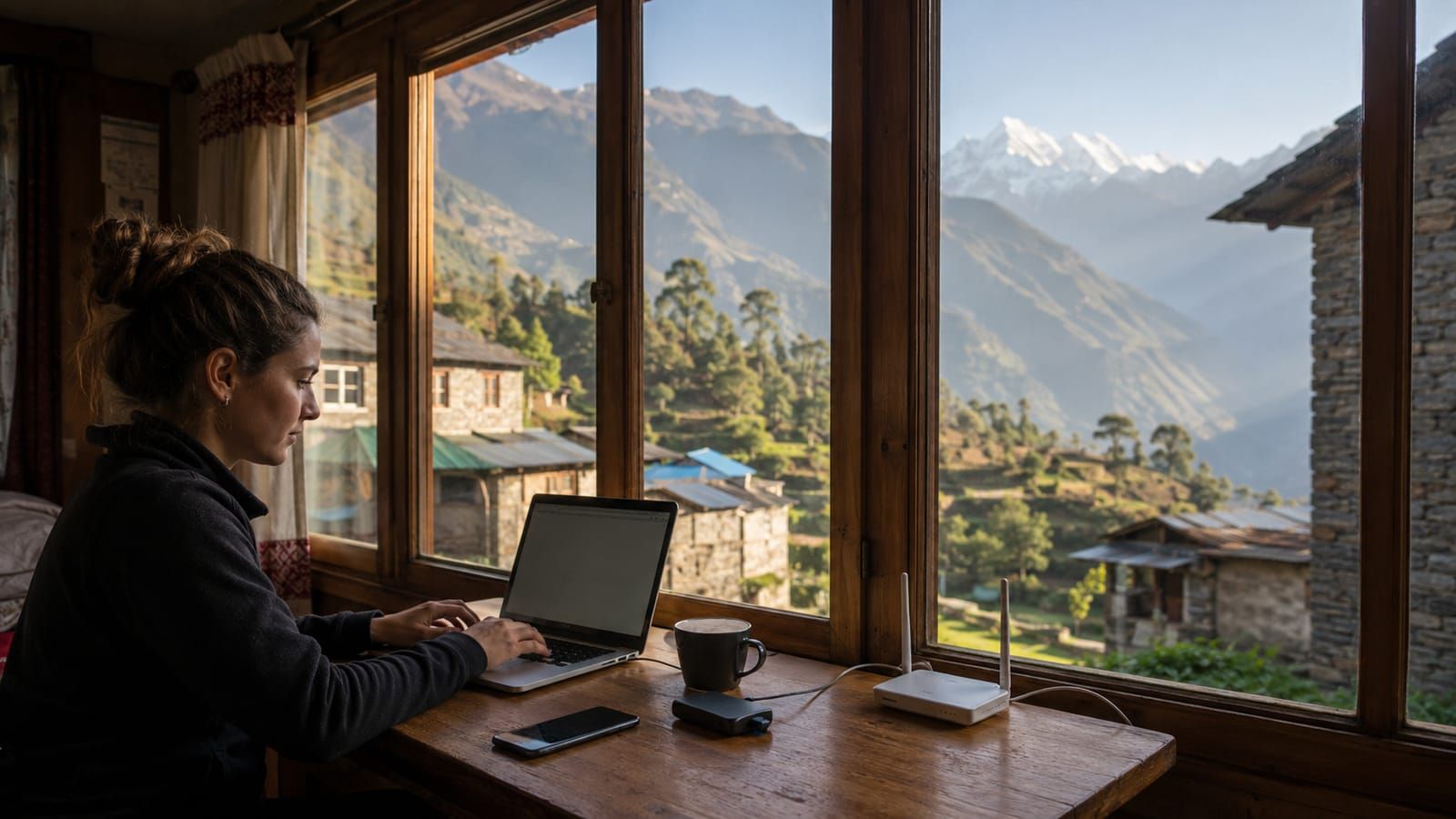
Recommend rural locations for
- Writing
- Research
- Design
- Asynchronous work
- Project planning
- Digital detox periods
- Short focused retreats
Do not rely on an unverified rural property for
- Daily high-stakes video meetings
- Large uploads
- Live broadcasting
- Customer-support shifts
- Work requiring guaranteed uptime
Does Nepal have a digital-nomad visa?
Nepal does not currently list a dedicated digital-nomad visa among its normal official visa categories. Tourist visas are commonly available for 15, 30 or 90 days, with extensions subject to current immigration rules and annual stay limits. A tourist visa should not automatically be interpreted as permission to work remotely.
Someone working online for an overseas employer or overseas clients should confirm their position directly with Nepal’s Department of Immigration. Local employment, providing services to Nepalese clients, operating a local company or earning Nepal-source income can involve different requirements.
Immigration permission and tax residence are different
Long stays can create tax-residency, reporting or permanent-establishment questions. Nepal’s tax rules commonly use a physical-presence threshold of 183 days within a consecutive 365-day period when determining whether a natural person is resident, but days present are not the only consideration relevant to every situation.
Tax treatment can depend on citizenship, existing tax residence, employer location, income source, company ownership, tax treaties and the nature of the work performed. NepalPick does not provide individual tax advice.
Source: Nepal Inland Revenue Department
Who can work comfortably from Nepal’s time zone?
Nepal Time (NPT) is Coordinated Universal Time plus 5 hours 45 minutes, UTC+5:45 — one of the more unusual offsets in the world. The overlap windows below are approximate normal office hours; verify daylight-saving changes on the other side of any call, since Nepal itself does not observe them.
| Region | Overlap with Nepal working hours |
|---|---|
| Asia | Excellent overlap |
| India | Near-complete overlap, Nepal is 15 minutes ahead of India Standard Time |
| Singapore, Hong Kong and parts of East Asia | Good overlap, with earlier Nepal starts |
| Central Europe | Useful Nepal afternoon and evening overlap with European morning and afternoon |
| United Kingdom | Useful Nepal afternoon and evening overlap |
| United States East Coast | Mostly Nepal evening and late-night overlap |
| United States West Coast | Very difficult for normal simultaneous office hours |
Europe-facing workers often find Nepal manageable. Workers required to match a full North American daytime schedule may need late-night or overnight hours.
When is the best time to work remotely from Nepal?
See best time to visit Nepal for the full seasonal picture; the summary below focuses on what each season means for a working stay. May sits between the spring and monsoon cards below: hot, increasingly humid and often hazy before sustained rain arrives. No season guarantees visible mountains.
Health, air quality and insurance
Pollution can worsen during dry winter and pre-monsoon periods because of traffic, road dust, construction, burning, brick kilns and regional pollution.
Recommended precautions
- Checking current Air Quality Index (AQI) conditions
- Choosing accommodation away from major roads
- Asking whether windows seal properly
- Using a genuine High-Efficiency Particulate Air (HEPA) purifier when conditions are poor
- Considering Pokhara or shorter Kathmandu stays if particularly sensitive
- Carrying necessary prescribed medication
- Not interpreting mountain views as proof of good air quality
Healthcare
Kathmandu has the broadest range of private hospitals and specialists. Pokhara can handle many routine needs. Complex emergencies elsewhere may require transfer, and remote mountain travel can be far from advanced care. For pre-trip vaccinations, water and food safety, and general medical-access preparation shared by every visitor (not just long-stay residents), see Nepal travel health.
Insurance should cover
- Hospital and outpatient care
- Medical evacuation
- Trekking altitude and maximum permitted elevation
- Motorcycle or scooter use
- Existing medical conditions
- Work equipment, if important
- Trip interruption
See Nepal travel insurance for why the altitude figure a policy states matters more than whether it mentions Nepal at all, especially if any side trip involves trekking.
Payments, cash and everyday administration
Nepal has a strong domestic Quick Response (QR) payment culture, but many local wallets and banking applications require Nepalese Know Your Customer (KYC) documentation or a local banking relationship. Foreign visitors should not assume they can immediately access every local payment system.
- Carrying Nepalese rupees
- Using reputable bank Automated Teller Machines (ATMs)
- Keeping a second payment card separately
- Informing the card provider about travel
- Checking foreign transaction and ATM fees
- Retaining cash for smaller businesses and rural areas
- Not depending exclusively on contactless cards
For general ATM limits, foreign-card fees, and card-acceptance patterns beyond long-stay banking, see money in Nepal.
Many hotels, larger restaurants and tourism businesses accept international cards, while cash remains useful. Eligible Indian users may find growing Unified Payments Interface (UPI) merchant acceptance, but availability is not universal.
What to ask before booking a remote-work stay
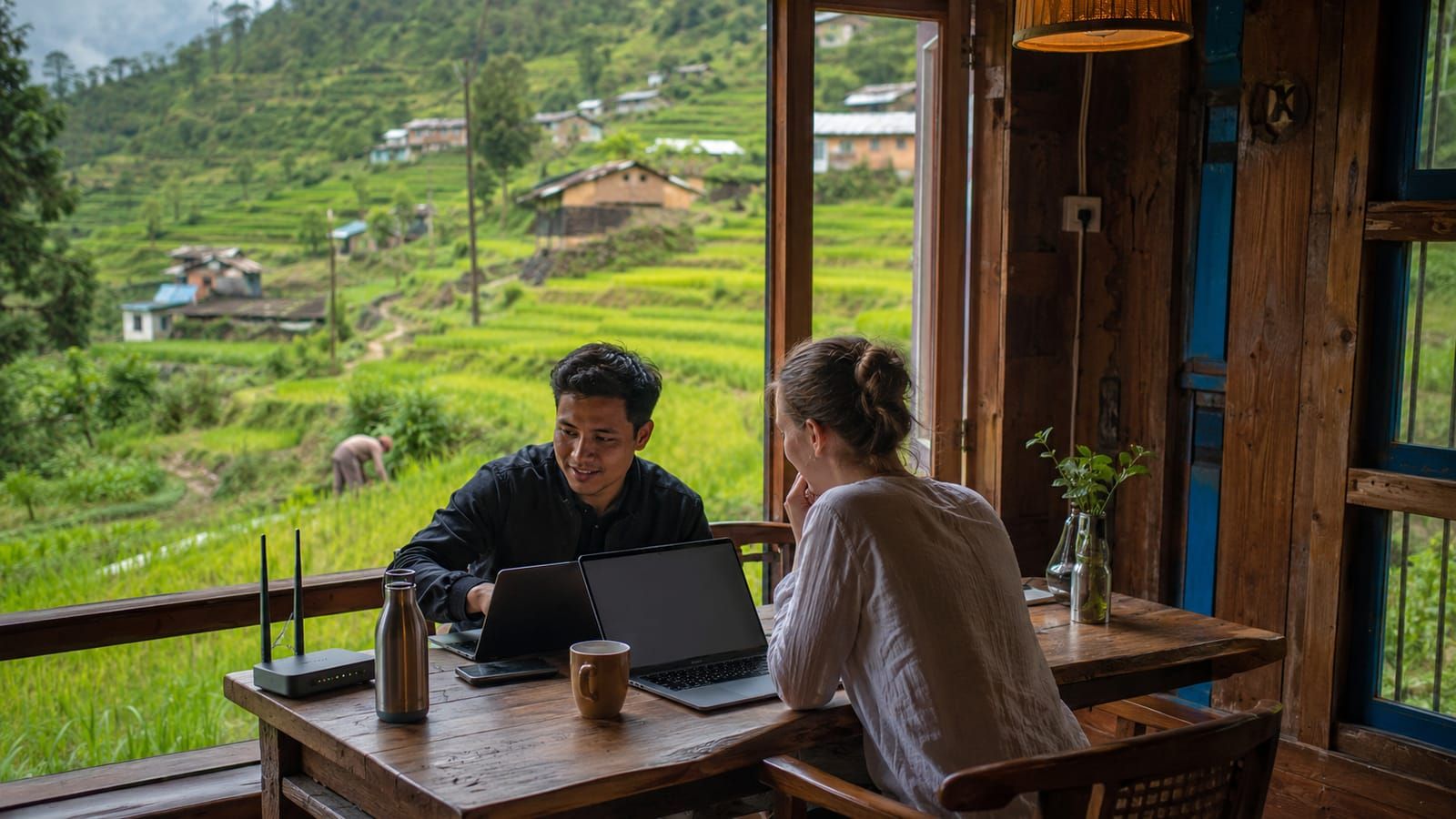
Internet
- Which ISP serves the property?
- Is the connection fibre?
- Is it shared?
- What are recent download and upload results?
- Is mobile signal available indoors?
- Is a second network available?
Power
- Is there an inverter, battery, solar system or generator?
- Does backup power support the router?
- Does it support the desk socket?
- How long does it normally last?
Workspace
- Is there a real desk and supportive chair?
- Is the room quiet during working hours?
- Is there natural light without severe screen glare?
- Can calls be taken privately?
- Is the room warm enough in winter or cool enough in summer?
Living conditions
- Is drinking-water treatment provided?
- Is hot water reliable?
- Is laundry available?
- How is waste managed?
- Is the property accessible during heavy rain?
- How far is the nearest clinic, grocery shop and ATM?
A practical first month working remotely from Nepal
| Week | Base | Purpose |
|---|---|---|
| Week 1 | Kathmandu or Patan | Arrival, mobile connection, adaptation, work setup, essential administration and heritage exploration |
| Week 2 | Continue in Patan or move to Pokhara | Establish a stable work routine and test the preferred working environment |
| Week 3 | Pokhara | Combine regular work with lake, hill and weekend activities |
| Week 4 | Verified rural retreat, Bandipur, Dhulikhel, Nagarkot or another connected property | Focused work, nature and slower travel |
For structuring time beyond the first month, see the Nepal itinerary guide and Nepal travel cost for wider trip budgeting alongside the monthly figures above.
Frequently asked questions
Is Nepal good for digital nomads?
Nepal can be an excellent choice for remote workers who value affordability, culture, nature and slower travel. Kathmandu, Patan and Pokhara offer the most practical infrastructure. Nepal remains less polished than established nomad hubs, and rural reliability must be verified individually.
Does Nepal have a digital-nomad visa?
Nepal does not currently list a dedicated digital-nomad visa among its normal official visa categories. Visitors intending to work remotely should confirm the correct immigration position with Nepal's Department of Immigration.
Can I work remotely on a Nepal tourist visa?
Do not assume that a tourist visa automatically authorises remote work. Rules can differ depending on the work, employer, clients and income source. Obtain current guidance directly from the Department of Immigration or a qualified adviser.
Is internet fast enough for video calls in Nepal?
Fibre connections in Kathmandu Valley and central Pokhara can support professional video calls, but performance differs by building and provider. Ask for recent upload, download and latency results, and keep mobile data on another network as backup.
Does Nepal still have load shedding?
Nepal's former system of scheduled nationwide load shedding ended in 2018. Local outages can still occur, so deadline-sensitive workers should choose accommodation with backup power for the router and desk socket.
How much does it cost to live in Nepal as a remote worker?
A careful one-person budget may begin around USD 650 to USD 900 per month, while a comfortable remote-worker lifestyle may cost roughly USD 1,000 to USD 1,500. Short-term furnished accommodation, international dining, coworking and frequent travel can increase the total substantially.
Which city is best for remote work in Nepal?
Patan offers the best overall balance for many long-stay workers. Kathmandu provides the widest range of services, while Pokhara offers the strongest work-life balance and access to nature.
Can I work remotely from rural Nepal?
Yes, but only after verifying the exact property. Rural internet, mobile coverage, power backup and road access vary considerably. Rural stays are often better for asynchronous or focused work than daily high-stakes meetings.
What is Nepal's time zone?
Nepal Time is UTC+5:45. It overlaps well with Asia and offers useful afternoon and evening overlap with Europe. Normal North American working hours usually require late-night work from Nepal.
Is Kathmandu air pollution a concern?
Yes. Air pollution can become unhealthy, especially during dry winter and pre-monsoon periods. Check current conditions, choose accommodation away from major roads and consider a properly rated air purifier.
Do foreign cards work in Nepal?
International cards are accepted by many hotels, larger restaurants and tourism businesses, but cash remains important. Local QR wallets may require Nepalese identification or banking access.
Should remote workers buy travel insurance for Nepal?
Yes. Insurance should cover medical treatment and evacuation. Travellers planning trekking should check altitude limits, activity exclusions and evacuation terms carefully.
Official sources and what to reconfirm
Prices, visa rules, mobile packages and service availability can change. Verify important arrangements directly with the relevant authority or provider before travelling. Budget ranges above are NepalPick editorial planning estimates, reviewed 31 August 2026 alongside the site’s NPR conversion rate, and should be reviewed again at least every six months.
Plan the rest of your Nepal trip
Once the logistics are clear, use the Nepal visa guide, Nepal travel cost, Nepal itinerary, and best time to visit Nepal to shape the wider journey around your working stay.